
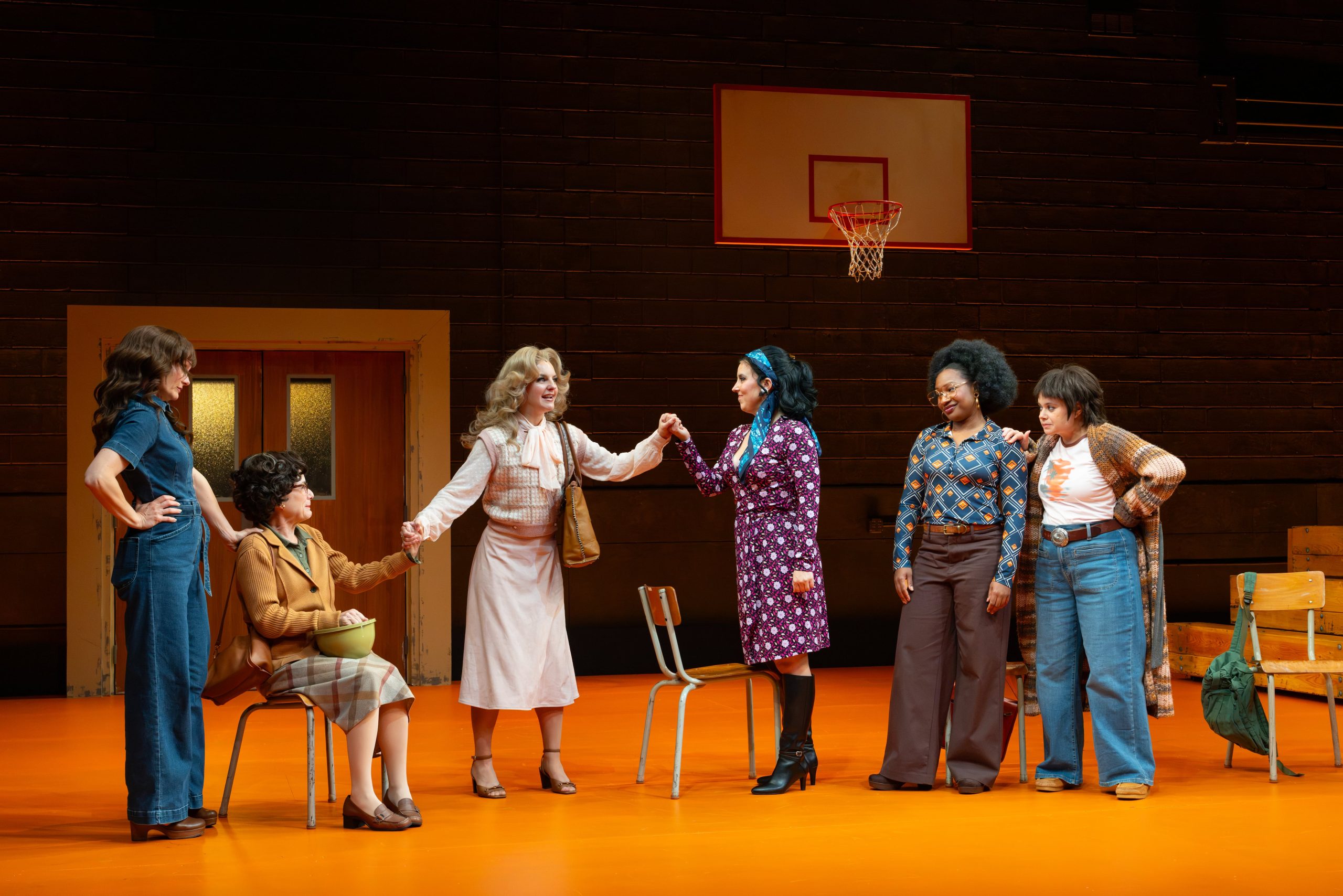
Bess Wohl’s new play Liberation had as great of a 2026 as you could imagine. After its limited Broadway run closed in February, it went on to win the Pulitzer Prize for Drama as well as the Tony Award for Best Play. Now, still in the year 2026, Liberation is making its regional debut right here in Philadelphia. Before this play debuts across the globe from London to Baltimore, Philadelphia Theatre Company has brought this profound new work to the Suzanne Roberts Theatre.
While Liberation is broadly about the second-wave feminism movement of the 1970s, describing its format isn’t easy. Playwright Bess Wohl tells a story that appears to be autobiographical, though beyond being inspired by her mother who once wrote for Ms. Magazine, doesn’t appear to be. The nameless main character begins the show like an impromptu address to the audience. She explains that she’s written a play about her mom who recently passed away, but who was a feminist activist in the 70s before settling down and raising a family. To better understand her mother now that she’s gone, the narrator decides to take us back to an Ohio gym in 1970 to tell her mom’s story. The narrator then spends the rest of the play alternating between playing herself exploring her mom’s history and portraying her mom Lizzie in the play the narrator has written. While it’s a complex concept on paper, it all becomes clear as the show unfolds.
Liberation touches on some incredibly resonant themes such as feminism, motherhood, intersectionality, memory, sexuality, activism, and much more. These topics resonate deeply and Wohl’s writing is excellent and thought-provoking. Some of the most poignant scenes are when the fourth wall is broken and some characters shift from their 1970s personas into modern-day performers operating with hindsight. The emotional highlight of the play is when the actress playing Margie offers to step in and possess the narrator’s recently departed mother so her daughter can get some answers one last time. Perhaps the buzziest moment when it was on Broadway is the opening of Act II when the cast performs completely naked. While nudity can occasionally be used gratuitously, in this case it’s incredibly effective. It happens when the activists in the 70s perform an exercise to say something they love and something they hate about their bodies. The vulnerability of both the characters and the actors is brave and powerful.
The acting across the board is truly outstanding. Julianna Zinkel is the lead performer, seamlessly balancing her role as Lizzie while guiding the audience through the whole play. Susan Rome plays Margie, an older housewife who wants to finally gain some autonomy now that her kids are fully grown. Rome’s dry humor and sympathetic performance are the heart of the whole play, and the mother/daughter scene she has with Zinkel is the anchor of its emotional impact. Anna Faye Lieberman’s Susan is a joy, delivering some hilarious lines with excellent delivery. Ciera Gardner as Celeste wonderfully displays a valuable perspective as a Black lesbian returning to Ohio to take care of her dying mom. Lee Minora as the Italian immigrant Isidora has some of the standout lines in the show, and her accent was effective and understandable. On the topic of accents, Campbell O’Hare does a perfect midwestern accent as Dora, a young and pretty woman who stumbles upon feminism. Nobody did regional accents on Broadway, but here the accent of O’Hare (as well as Susan Rome) grounds the story to the specific setting of 1970s Ohio. Rounding out the cast are Noelle Diane Johnson as Joanne and Brett Mack as Bill, all with smaller roles that feature excellent scenes. Johnson’s fourth wall breaks in particular delivered thought-provoking humor.
Everything about this production of Liberation was first rate. That Philadelphia Theatre Company was given the honor of performing the first regional production of the Pulitzer and Tony winner is a credit to the exciting work PTC is doing. Liberation has a lot to say on a whole range of evergreen subjects. It explores them thoughtfully and wisely, always challenging the audience to think. This is a play that simply must be seen, and Philadelphia is fortunate that one of its first productions (of what will undoubtedly be many) is right here at the Suzanne Roberts Theatre.